Why Offline-First Software Wins for Small Businesses
Spotty Wi-Fi shouldn't stop you from invoicing a customer standing right in front of you.
Why Offline-First Software Wins for Small Businesses
Running a small business is already challenging enough.
You have customers to serve, invoices to create, payments to track, products to manage, and countless decisions to make every day.
The last thing you need is for your business software to stop working because your internet connection disappeared.
That's why offline-first software is becoming increasingly important for small businesses.
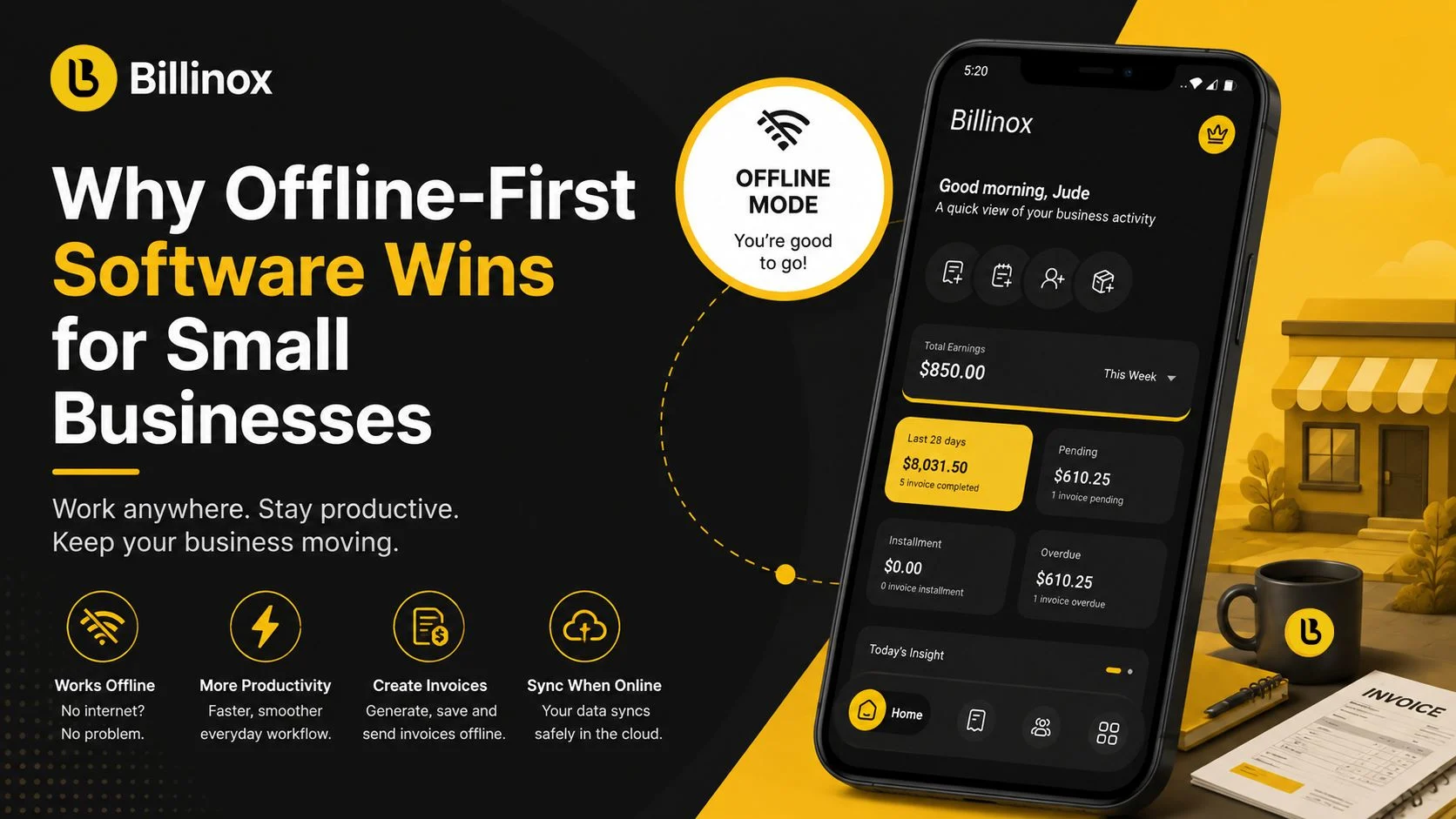
Instead of assuming that you will always have a reliable internet connection, offline-first applications are designed to let you keep working even when you're offline.
And for many small businesses, that isn't just a nice feature.
It's a necessity.
What Does "Offline-First" Actually Mean?
Offline-first software is designed around a simple idea:
Your application should work even when the internet doesn't.
Traditional online applications often depend heavily on an internet connection. If the connection becomes slow or unavailable, the application may become difficult or impossible to use.
An offline-first app takes a different approach.
You can continue performing important tasks while offline, and your information can synchronize when you're connected again.
This makes the software more reliable, especially for people who work from different locations or deal with inconsistent internet access.
Why Internet Dependency Can Hurt Small Businesses
For large organizations with dedicated infrastructure and reliable connectivity, an internet outage may be an inconvenience.
For a small business, it can bring important tasks to a standstill.
Imagine you're meeting a customer and need to:
- Create an invoice
- Check a previous invoice
- Confirm a payment
- Look up a customer's information
- Review a quotation
- Record a new transaction
Then your internet connection drops.
If your business software requires an internet connection for everything, you may have to wait.
And when you're dealing directly with a customer, waiting isn't always an option.
Offline-first software removes that unnecessary dependency.
1. Keep Working When You're Offline
This is the biggest advantage of offline-first software.
You can keep working.
Whether you're in your shop, at a customer's location, traveling, or somewhere with poor network coverage, you don't have to stop your workflow simply because your connection isn't available.
For small businesses, this can make a huge difference.
You can create an invoice now instead of remembering to do it later.
You can record a payment immediately instead of keeping notes somewhere and updating your records hours later.
You can access information when you need it instead of waiting for a connection.
That's what good business software should do: fit into your workflow, not interrupt it.
2. Faster Business Apps
Offline-first software can also feel faster.
Why?
Because many actions can happen directly on your device instead of waiting for a server to respond.
When you add a customer, create an invoice, or update a product, you don't necessarily have to wait for a network request to complete before seeing the result.
The result is a more responsive experience.
And when you're using an app repeatedly throughout the day, those few seconds saved on individual actions can add up.
Fast software helps you spend less time managing your business and more time running it.
3. Perfect for Businesses on the Move
Not every business operates from a desk with a reliable Wi-Fi connection.
Many small businesses are mobile.
Think about:
- Freelancers
- Contractors
- Plumbers
- Electricians
- Photographers
- Repair technicians
- Consultants
- Delivery businesses
- Field sales representatives
- Small retailers
- Service providers
These businesses often work wherever their customers are.
An offline business app gives them the flexibility to work from virtually anywhere.
You shouldn't have to search for Wi-Fi before you can send an invoice.
4. Better for Unreliable Internet Connections
Internet connectivity can be unpredictable.
You might have a strong connection in the morning and struggle with it later.
You might move into an area with poor coverage.
Your ISP might experience an outage.
Your mobile data might run out.
Or your connection might simply become too slow to use comfortably.
Offline-first software gives your business a safety net.
Instead of treating every connectivity problem as a software problem, you can simply continue working.
Once you're connected again, your data can synchronize.
5. Great for Invoicing
Invoicing is one area where offline-first software can be particularly useful.
Imagine finishing a job and needing to send your customer an invoice immediately.
You shouldn't have to say:
"I'll send the invoice when I get back online."
With an offline invoicing app, you can create the invoice while you're still with the customer.
You can add the products or services, calculate the total, save the invoice, and continue with your day.
This makes invoicing more immediate and professional.
And the faster you can create and send invoices, the faster you can potentially get paid.
6. Fewer Interruptions to Your Business
Small businesses thrive on momentum.
A customer conversation leads to an order.
An order leads to an invoice.
An invoice leads to a payment.
Every unnecessary interruption creates friction.
If your business application keeps asking you to reconnect, refresh, retry, or wait for a server, that friction quickly becomes frustrating.
Offline-first software removes one of those interruptions.
Your workflow can continue naturally.
Open the app. Do the work. Save it. Keep moving.
7. Your Business Doesn't Stop at the Edge of Wi-Fi
This is perhaps the simplest way to understand the value of offline-first software.
Your business isn't limited to places with perfect internet.
Your customers don't care whether your network connection is strong.
They care whether you can provide the service they need.
Whether you're working from a busy market, visiting a customer, attending an event, or operating in an area with unreliable connectivity, your business software should be ready to work with you.
That's where offline-first design shines.
Offline-First Doesn't Mean "No Cloud"
There's an important distinction.
Offline-first software isn't necessarily cloud-free software.
The best offline-first applications can give you the advantages of both approaches.
You can work locally when you're offline and synchronize your information when you're connected.
That means you can get:
- Offline access
- Fast performance
- Cloud backup
- Synchronization
- Multi-device access
- Greater flexibility
You don't have to choose between offline functionality and cloud technology.
You can have both.
Why This Matters for Small Businesses in Africa
Reliable internet access is particularly important when designing software for markets where connectivity can vary significantly.
Many entrepreneurs operate primarily from mobile devices.
They may rely on mobile data, move between locations frequently, or work in areas where network quality isn't always predictable.
For these businesses, offline-first mobile apps aren't just convenient—they can be practical business tools.
Software should adapt to the environment where businesses operate.
It shouldn't assume that every entrepreneur has unlimited data and a perfect internet connection.
Offline-First Software Is About Reliability
At the end of the day, the biggest benefit isn't really about being offline.
It's about reliability.
You want your business tools to be available when you need them.
You don't want your ability to create an invoice to depend entirely on your network connection.
You don't want to lose momentum because an application can't reach a server.
And you shouldn't have to change how you work just because your internet connection changed.
Reliable software gives you confidence.
Why We Believe Offline-First Matters at Billinox
At Billinox, we believe invoicing software should work around the realities of small businesses.
That's why offline functionality is an important part of the Billinox experience.
Whether you're creating an invoice, managing customers, tracking payments, or keeping your business records organized, you should be able to get things done without constantly worrying about your internet connection.
Because running a business is already complicated enough.
Your invoicing app shouldn't make it harder.
The Future of Small Business Software Should Be More Flexible
The best small business software isn't necessarily the one with the most features.
It's the one that works when you need it.
It's fast.
It's simple.
It's reliable.
And it doesn't get in your way.
That's why offline-first software is such a powerful approach for small businesses.
The internet should enhance your business software—not determine whether it works.
Final Thoughts
Small businesses need technology that works in the real world.
And the real world doesn't always have perfect internet.
Sometimes the connection is slow.
Sometimes it's unavailable.
Sometimes you're simply somewhere without it.
Your business still needs to operate.
That's why offline-first applications are becoming increasingly valuable.
They give small business owners something incredibly important:
the ability to keep working.
And when your software works wherever your business takes you, everyone wins.
Your business shouldn't go offline just because your internet does.
Frequently Asked Questions
What is offline-first software?
Offline-first software is designed to keep working without a constant internet connection. Users can perform important tasks offline and synchronize their data when connectivity returns.
Why is offline-first software good for small businesses?
It allows small businesses to continue working during internet outages, poor connectivity, or when operating in locations without reliable internet access.
What is an offline invoicing app?
An offline invoicing app allows businesses to create, manage, and store invoices without requiring an active internet connection for every task.
Can offline-first apps sync with the cloud?
Yes. Many offline-first applications store information locally and synchronize it with cloud services when an internet connection becomes available.
Is offline-first software useful for mobile businesses?
Absolutely. Freelancers, contractors, field workers, retailers, service providers, and other mobile businesses can benefit significantly from software that works without constant connectivity.
Does offline-first mean I can't use multiple devices?
Not necessarily. An offline-first application can support synchronization between multiple devices, allowing users to work locally while keeping their information synchronized when connected.